Emirates Hills Dubai Area Guide 2026: Villas, Prices, Lifestyle & Investment Insight
If there is one address in Dubai that signals “you have arrived,” it is Emirates Hills. Locals call it the Beverly Hills of Dubai, and the comparison isn’t just marketing — it was intentional. When Emaar Properties designed this community in the early 2000s, it deliberately modeled the concept on the Californian hillside enclave, right down to letting owners build their own architect-designed mansions on blank “white plots” rather than buying a standardized villa off a brochure.
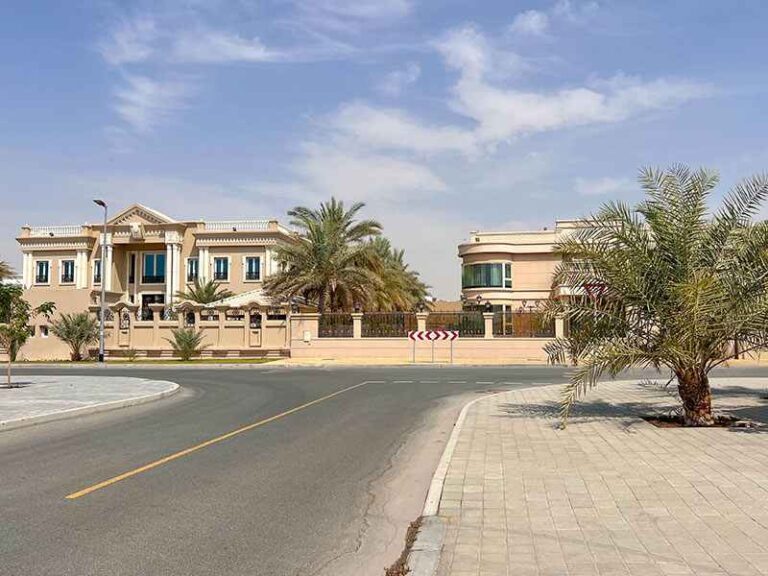
That single decision is why Emirates Hills looks and feels different from almost every other villa community in Dubai today. There is no repeating façade, no identical rooflines — just 600-plus custom mansions wrapped around lakes, golf fairways, and manicured gardens, home to business magnates, royalty, and some of the wealthiest families in the Gulf.
This guide goes beyond the usual “villas and golf course” overview you’ll find elsewhere. It covers the freehold history that makes Emirates Hills legally and structurally unique, how pricing and off-market deals actually work in 2026, what buying, renting, or rebuilding here really costs, and how the community compares to its closest rivals — Palm Jumeirah, Dubai Hills Estate, and Jumeirah Golf Estates — so you can decide whether it is the right fit for your lifestyle or portfolio.
What Is Emirates Hills? A Quick Answer
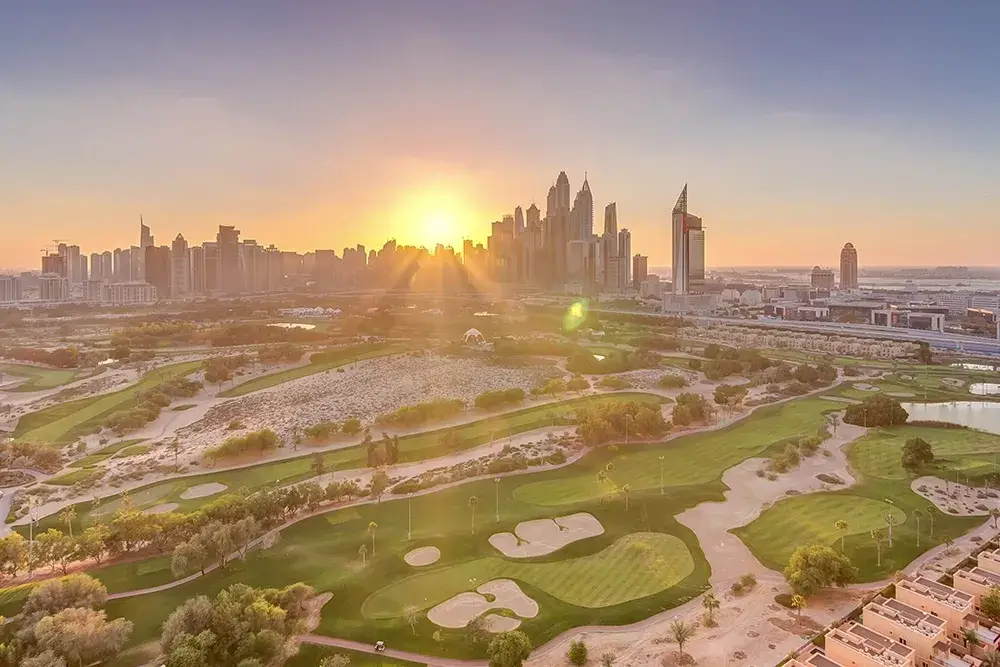
Emirates Hills is a gated, freehold villa community in Dubai developed by Emaar Properties, built around the 18-hole Montgomerie Golf Club. It forms part of the wider Emirates Living master development, alongside The Meadows, The Springs, The Lakes, and Jumeirah Islands. Unlike most Emaar communities, Emirates Hills was sold as individual land plots, letting buyers design and construct fully custom mansions — which is why it is often described as Dubai’s version of Beverly Hills.
The History and Concept Behind Emirates Hills
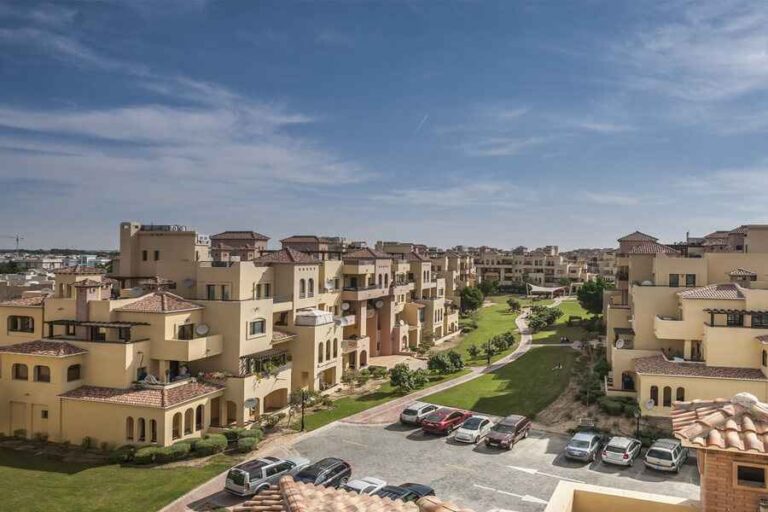
Emirates Hills was launched in the early 2000s as part of Emaar’s Emirates Living master plan, a cluster of family-oriented freehold communities on the western edge of the city, close to what is now Dubai Marina and Sheikh Zayed Road. While the surrounding communities — The Springs, The Meadows, The Lakes — were built with standardized villa designs at a range of price points, Emirates Hills was positioned differently from day one.
Emaar sold Emirates Hills as “white plots”: empty parcels of land, priced per square foot, with no house attached. Buyers then hired their own architects and contractors to build a home entirely to their own specification. This is still the only Emaar project built this way, and it explains the architectural diversity that defines the community — Mediterranean villas sit beside Arabian-influenced mansions, contemporary glass structures, and even a Versailles-inspired estate known locally as “the Marble Palace,” which reportedly took 12 years and around 700,000 sheets of gold leaf to complete.
The result, two decades later, is a community regarded as Dubai’s “old-money enclave”: an address where land value, privacy, and legacy matter more than square footage or amenity checklists.
Emirates Hills Location and Connectivity
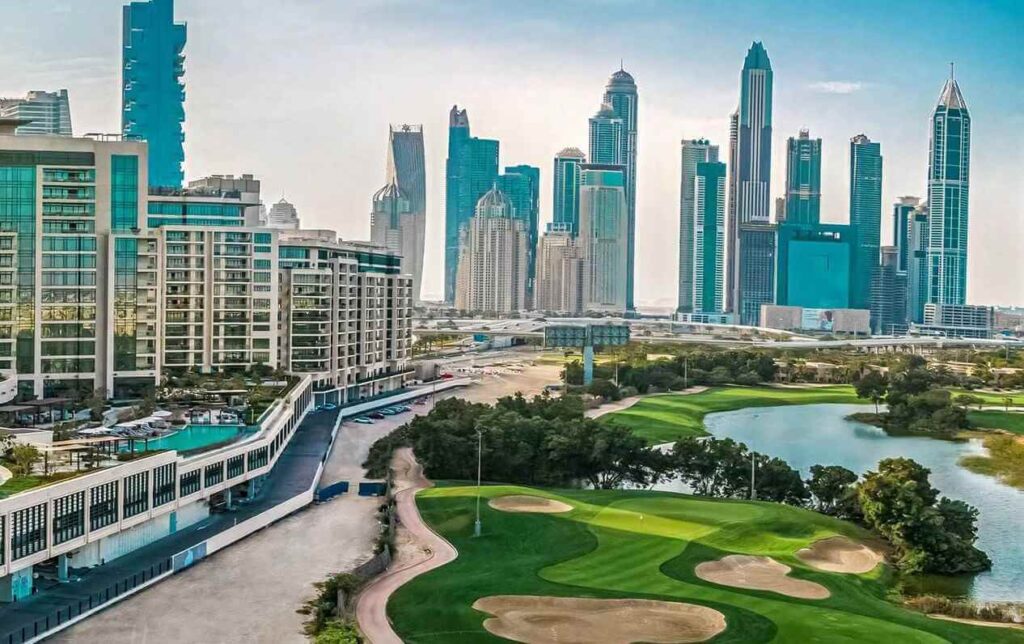
Emirates Hills sits inland from Dubai Marina and the Palm, roughly seven minutes from Sheikh Zayed Road and about 15 minutes from the beach clubs and restaurants of Dubai Marina. It is bordered by The Lakes to the northeast, The Springs to the south, and Jumeirah Islands and Jumeirah Park to the west – placing it at the geographic heart of the Emirates Living cluster rather than on its edge.
Approximate drive times from Emirates Hills:
| Destination | Approximate Drive Time |
|---|---|
| Sheikh Zayed Road | 7 minutes |
| Dubai Marina / JBR | 13–17 minutes |
| Downtown Dubai / Burj Khalifa | 20–22 minutes |
| Dubai International Airport (DXB) | 30 minutes |
| Palm Jumeirah | 13 minutes |
Public transport within the community itself is minimal by design — this is a low-density, car-dependent enclave — but nearby metro stations along the Red Line and bus stops on Sheikh Zayed Road provide alternatives for staff and visitors.
Villa Clusters and Property Types
Emirates Hills is organized into distinct sub-communities, or “sectors,” each with a slightly different character, plot size, and price bracket. The main clusters include:
Signature Villas — among the most extravagant addresses in the community, with branded villas ranging roughly from 678 to 1,487 square meters of built-up area, plus standalone building plots between 1,115 and 4,180 square meters. Residents share a communal pool, playgrounds, and landscaped walking gardens.
Montgomerie Maisonettes — three- to four-bedroom villas directly overlooking the Montgomerie Golf Course, generally positioned as a (relatively) more accessible entry point into the community, with shared pool and park facilities.
Mansion / Custom-Build Plots — the true “white plot” segment, where buyers acquire raw land or an older structure with the intention of demolishing and rebuilding a bespoke estate. This is the segment most associated with the community’s headline-grabbing nine-figure transactions.
Across the community, plot sizes typically range from around 12,000 square feet up to 45,000–58,000 square feet, with villa configurations spanning five to nine bedrooms, and a small number of larger estates exceeding that.
How Much Does a Villa in Emirates Hills Cost in 2026?
Pricing in Emirates Hills does not behave like a typical Dubai villa market, and this is where most generic area guides fall short. Because homes are custom-built and land is the scarcest resource, price ranges are extremely wide and heavily dependent on plot location, view, and finish quality rather than a standard price-per-square-foot benchmark.
Quick answer: As of 2026, entry-level unrefurbished villas in Emirates Hills start from roughly AED 18–35 million, fully refurbished mansions typically trade between AED 80–150 million, and record-breaking estates with dual golf-course and Marina-skyline views have sold for AED 250 million or more.
| Segment | Approx. Price Range (2026) |
|---|---|
| Entry-level, unrefurbished villa | AED 18–35 million |
| Mid-tier renovated villa (5–6 bed) | AED 35–80 million |
| Fully refurbished mansion | AED 80–150 million |
| Trophy / record estate | AED 200–425 million+ |
| Price per sq ft (turnkey mansions) | AED 3,500–6,000 |
| Premium lake/golf-view plots (per sq ft) | AED 2,000–4,500 |
| Rare high-ground lake plots (per sq ft) | AED 4,500–7,000+ |
For context on scale: in 2025, steel magnate Lakshmi Mittal acquired a Baroque-style mansion in Emirates Hills reported to have cost in the region of AED 367–425 million, while a lake-and-golf-facing villa sold for roughly AED 260 million (about AED 18,500 per square foot) in August 2025 – figures that placed Emirates Hills among the highest per-square-foot residential sales ever recorded in Dubai.
Rental Prices
Emirates Hills is a landlord’s market rather than a high-turnover rental hub. A five-bedroom villa typically rents for approximately AED 1.9 million per year, with smaller or older properties available from a few hundred thousand dirhams less. Because so few properties turn over, rental listings tend to move quickly and are often handled privately rather than through public portals.
Rental Yield and ROI
Gross rental yields in Emirates Hills are modest compared to mid-market Dubai communities — typically in the 2–5% range, with six-bedroom villas at the upper end (around 5.2%) and average community-wide yields closer to 2–3%. This is normal for ultra-prime, low-density markets: investors here are generally underwriting capital appreciation and legacy value rather than rental income. Elite Dubai neighborhoods, Emirates Hills included, have shown annual capital gains in the 10–20% range in recent cycles, driven by scarcity of land rather than new supply.
The Off-Market Reality: How Emirates Hills Deals Actually Happen
One of the least-explained aspects of this market is how transactions occur. Unlike mid-market Dubai communities where listings sit openly on property portals, an estimated 70% or more of Emirates Hills sales are conducted off-market, through trusted private brokers and family offices, specifically to protect the privacy of high-profile buyers and sellers. If you are researching this community with a genuine acquisition budget, working with an agency that has established relationships inside Emirates Hills — rather than relying solely on public listing sites — is often the difference between seeing real inventory and seeing only what’s publicly advertised.
The “Demolish and Rebuild” Strategy
Because true vacant “white plots” are now essentially unavailable on the open market, the most common route to a fully custom mansion today is to purchase an older villa — ideally on a prime lake- or golf-facing plot — at a price close to the land’s underlying value, then demolish and rebuild. This strategy has become the de facto way serious buyers secure bespoke homes in a community where blank land no longer changes hands publicly.
Golf Course Access and the Address Montgomerie
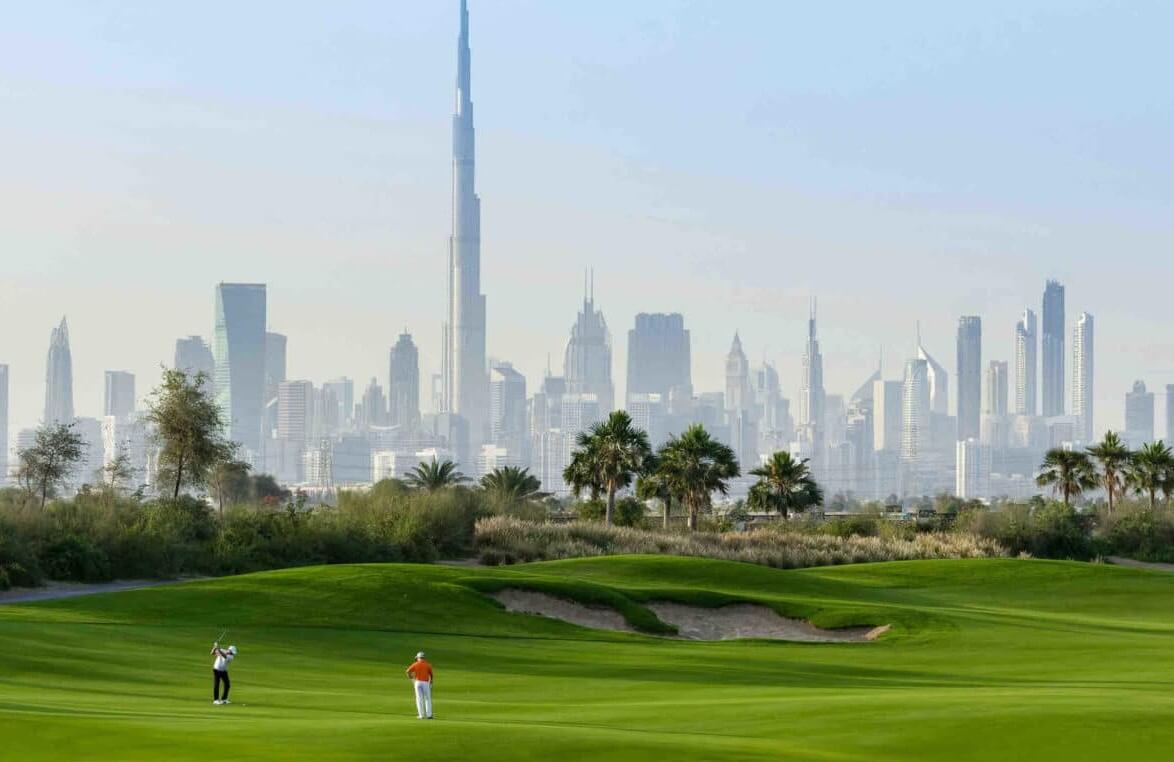
The Montgomerie Golf Club – designed by golf course architect Desmond Muirhead in collaboration with Scottish golfer Colin Montgomerie – is the community’s centerpiece. Villas along the fairways enjoy direct course views, and residents typically benefit from preferential access or membership arrangements through the Address Montgomerie, the five-star hotel and clubhouse anchoring the course. The neighboring Emirates Golf Club, home to the Dubai Desert Classic, adds a second world-class course within easy reach, reinforcing Emirates Hills’ identity as a genuine golf-lifestyle address rather than simply a villa community that happens to be near a course.
Lifestyle, Amenities, and Everyday Living
Emirates Hills is deliberately quiet on retail. There is no community mall inside the gates — residents drive a few minutes to The Springs Souk or The Meadows Souk for cafés and daily essentials, or further afield to Dubai Marina Mall or Dubai Mall for full retail and dining. What the community lacks in ground-floor retail, it makes up for in green space: lakes, jogging and cycling paths, tennis courts, and dedicated children’s play areas are woven throughout the sectors, alongside amenities like the Lakes Club and nearby Fitness First facilities.
Security is a defining feature rather than an afterthought. Emirates Hills operates as a fully gated community with round-the-clock manned security and surveillance, which – combined with the absence of hotels or tourist footfall – is a large part of why high-profile residents, from business leaders to public figures, have chosen it over more visible waterfront addresses.
Schools Near Emirates Hills
Families relocating to Emirates Hills have strong access to international curricula within a short drive:
- Dubai British School — located within Emirates Hills itself, offering the British curriculum from Foundation Stage through Year 13.
- Dubai International Academy — nearby, offering the International Baccalaureate (IB) programme.
- Emirates International School and Raffles Nursery — both within a few minutes’ drive, covering early years through secondary education.
Emirates Hills vs. Palm Jumeirah vs. Dubai Hills Estate
Prospective buyers frequently weigh Emirates Hills against Dubai’s other trophy addresses. Here is how they differ in practice:
| Factor | Emirates Hills | Palm Jumeirah | Dubai Hills Estate |
|---|---|---|---|
| Property type | Custom-built villas/mansions | Villas, apartments, branded residences | Villas, townhouses, apartments |
| Defining feature | Golf course + total privacy | Beachfront + skyline views | Green space + golf + family retail |
| Tourist footfall | Very low | High | Low-moderate |
| Typical buyer | Legacy wealth, privacy-focused | Lifestyle + short-let investors | End-users, growing families |
| Entry price point | Very high (AED 18M+) | High, wide range | Mid-to-high, broader range |
| Retail within community | Minimal | Extensive | Dubai Hills Mall on-site |
| Rental yield profile | Low (2–5%), capital-growth focus | Moderate-high, strong short-let demand | Balanced, family long-let demand |
In short: choose Palm Jumeirah for beachfront lifestyle and stronger rental liquidity, Dubai Hills Estate for a family-friendly, amenity-rich master community with better yield, and Emirates Hills for maximum privacy, land scarcity, and long-term legacy value with minimal income focus.
Who Lives in Emirates Hills?
Emirates Hills has built its reputation partly through its residents. Over the years the community has been home to prominent regional business figures, members of well-known industrial families, senior executives, and international public figures, reinforcing its status as one of the Gulf’s most exclusive residential addresses. This concentration of high-net-worth ownership is itself a market signal: it sustains land values even during broader market corrections, because sellers are rarely under financial pressure to discount.
Buying Process and Costs for Foreign Investors
Emirates Hills sits within a designated freehold zone, meaning buyers of any nationality can purchase full ownership of land and property, registered through the Dubai Land Department (DLD). Standard transaction costs to budget for include:
- A DLD transfer fee, generally around 4% of the purchase price.
- Agency commission, typically negotiated per transaction given the scale of deals.
- Legal and due-diligence fees, particularly important for demolish-and-rebuild acquisitions where title, setback rules, and building permissions need verification.
- Ongoing community service charges, payable to Emaar for the upkeep of lakes, landscaping, roads, and security.
Given the scale of capital involved and the prevalence of off-market deals, independent legal representation and an accurate, licensed valuation are strongly recommended before any offer is made.
Is Emirates Hills a Good Investment in 2026?
For income-focused investors chasing high rental yield, Emirates Hills is not the obvious choice — yields of 2–5% trail well behind mid-market Dubai communities. But for capital preservation and long-term appreciation, the calculus is different. Land in Emirates Hills is finite, new supply is effectively impossible since the community is fully built out, and demand from ultra-high-net-worth buyers globally has continued to push record transactions through 2025 and into 2026. Many advisors now frame prime Emirates Hills real estate less as a rental-yield asset and more as a “legacy asset” — comparable to holding blue-chip land in Beverly Hills or Kensington — where wealth preservation and prestige, not annual income, are the primary return.
Key Takeaways
- Emirates Hills is Emaar’s only “white plot” community in Dubai, which is why villa architecture varies so widely from house to house.
- 2026 entry prices start around AED 18–35 million, with fully refurbished mansions commonly trading between AED 80–150 million and trophy estates exceeding AED 250 million.
- Roughly 70% of transactions happen off-market through private brokers rather than public listings.
- Gross rental yields (2–5%) are lower than most Dubai communities; the investment case rests on capital appreciation and scarcity, not income.
- The community is anchored by the Montgomerie Golf Club and sits within easy reach of Dubai British School, Dubai International Academy, and Sheikh Zayed Road.
- It is a fully freehold zone, open to foreign ownership, registered through the Dubai Land Department.
Frequently Asked Questions
Is Emirates Hills a gated community?
Yes. Emirates Hills is a fully gated, privately secured community with 24-hour manned security and surveillance, and it does not permit through-traffic from surrounding areas.
Who developed Emirates Hills?
Emirates Hills was developed by Emaar Properties as part of its Emirates Living master plan, alongside The Meadows, The Springs, The Lakes, and Jumeirah Islands.
Can foreigners buy property in Emirates Hills?
Yes. Emirates Hills is a designated freehold zone, meaning buyers of any nationality can hold full ownership of land and villas, registered through the Dubai Land Department.
Why is Emirates Hills called the Beverly Hills of Dubai?
Emaar deliberately modeled the community’s concept on Beverly Hills, California — selling empty land plots for buyers to design fully custom mansions, rather than pre-built standardized villas, which is unique among Emaar’s Dubai projects.
How much does a villa in Emirates Hills cost in 2026?
Entry-level unrefurbished villas start around AED 18–35 million, fully refurbished mansions typically range from AED 80–150 million, and record trophy estates have sold for AED 250–425 million or more.
What is the rental yield in Emirates Hills?
Gross rental yields in Emirates Hills typically range between 2% and 5%, lower than most Dubai communities, since the market is driven primarily by capital appreciation rather than rental income.
Are there vacant plots still available in Emirates Hills?
Genuinely vacant “white plots” are effectively unavailable on the open market today. Most buyers seeking a fully custom home now purchase an older villa on a prime plot and rebuild.
Does Emirates Hills have a golf course?
Yes. The community is built around the 18-hole Montgomerie Golf Club, designed by Desmond Muirhead with Colin Montgomerie, and anchored by the five-star Address Montgomerie hotel and clubhouse.
Is there a shopping mall in Emirates Hills?
No. Emirates Hills has no community mall within its gates. Residents typically drive a few minutes to The Springs Souk or The Meadows Souk, or further to Dubai Marina Mall or Dubai Mall.
How far is Emirates Hills from Dubai Marina?
Emirates Hills is approximately 13–15 minutes by car from Dubai Marina and Jumeirah Beach Residence (JBR).
What schools are near Emirates Hills?
Dubai British School sits within the community itself, while Dubai International Academy, Emirates International School, and Raffles Nursery are all a short drive away.
Is Emirates Hills better than Palm Jumeirah for investment?
It depends on your goal. Palm Jumeirah generally offers stronger rental yields and liquidity due to tourism and short-let demand, while Emirates Hills offers greater privacy, land scarcity, and historically strong capital appreciation, with lower rental income.
How many villas are in Emirates Hills?
Estimates place the community at roughly 600–640 villas and mansions across its various sectors, though exact counts vary slightly as older properties are demolished and rebuilt.

- Ismail Kouami: The Dubai Entrepreneur Building Companies Across Fintech, Mobility and Software - September 13, 2026
- 7 Costly Mistakes Entrepreneurs Make Before Hiring Company Setup Consultants in Dubai - September 5, 2026
- How Monthly Car Hire Simplifies Transportation During Home Relocations - July 27, 2026