Dubai International Financial Centre Area Guide 2026
Most guides to the Dubai International Financial Centre pick a lane. Real estate portals talk about apartments and metro stations. Legal sites talk about the DFSA and common law. Business-setup agencies talk about licence fees. None of them explain the thing that actually matters: DIFC is one of the only places on earth where a foreign-owned company can operate under English common law, pay zero corporate tax on qualifying income for fifty years, and have its founders live a five-minute walk from their office in a district that also happens to be one of Dubai’s best neighbourhoods for dining, art, and city living.
That combination – independent jurisdiction plus lived-in urban district — is why DIFC keeps showing up in unrelated conversations: someone asking where to register a fintech startup, someone else asking where to rent a two-bedroom apartment near Downtown Dubai, and a third person asking where the Ritz-Carlton in Dubai’s financial district actually is. They’re all asking about the same 110 hectares of land.
This guide brings all three conversations together. You’ll get the legal and regulatory backbone of DIFC, what it actually costs and takes to set up a business there in 2026, what life looks like if you rent or buy in the district, and the numbers behind DIFC’s expansion this year – including data most guides haven’t caught up to yet.
What Is DIFC? A Quick Definition
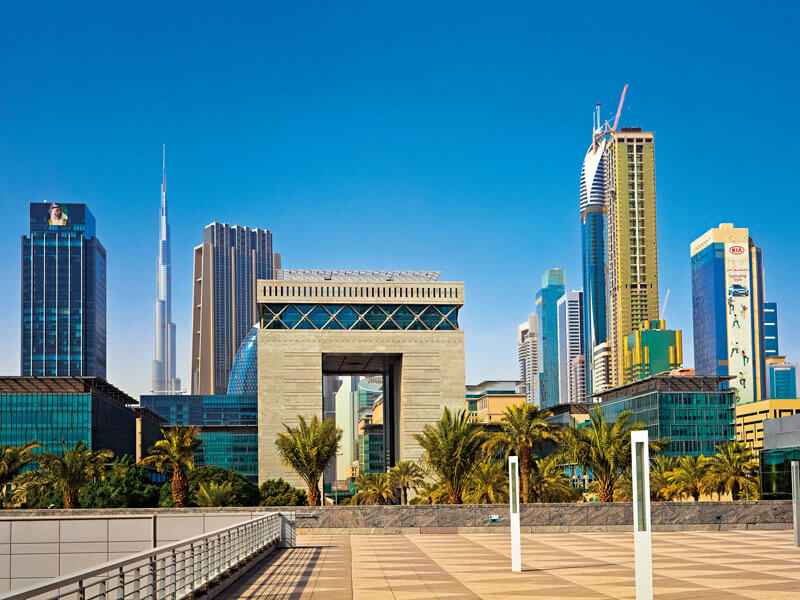
Dubai International Financial Centre (DIFC) is a 110-hectare special economic zone in the centre of Dubai, established in 2004 as a financial free zone for companies serving the Middle East, Africa, and South Asia (MEASA) region. It operates under its own legal system based on English common law, its own courts (DIFC Courts), and its own financial regulator (the Dubai Financial Services Authority, or DFSA) – independent of both UAE federal civil law and Dubai’s local regulatory bodies for financial matters.
DIFC is simultaneously three things: a regulatory jurisdiction, a business district, and a residential and lifestyle neighbourhood. Understanding it means understanding how those three layers sit atop one another in the same physical space.
Where DIFC Sits in Dubai?
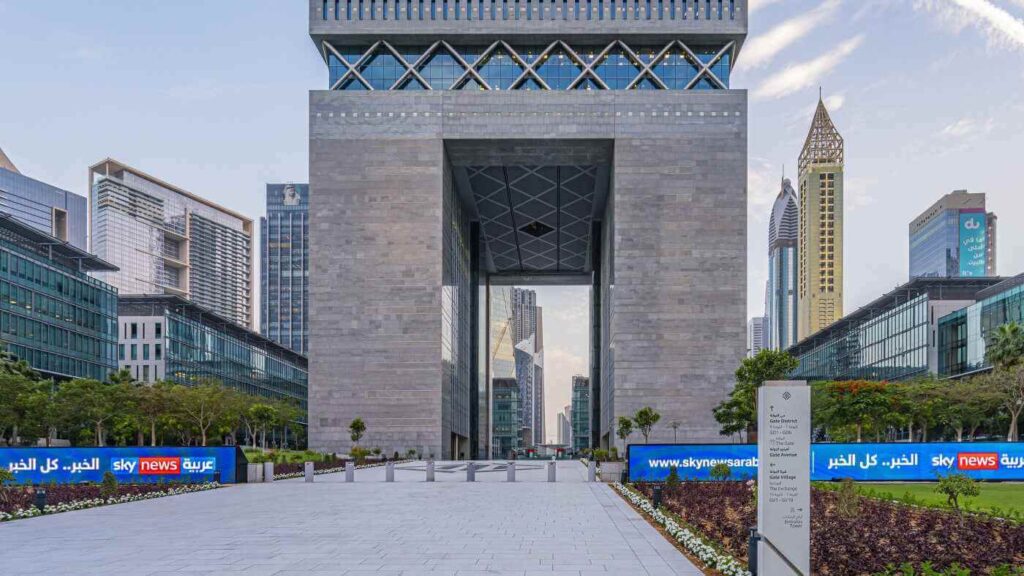
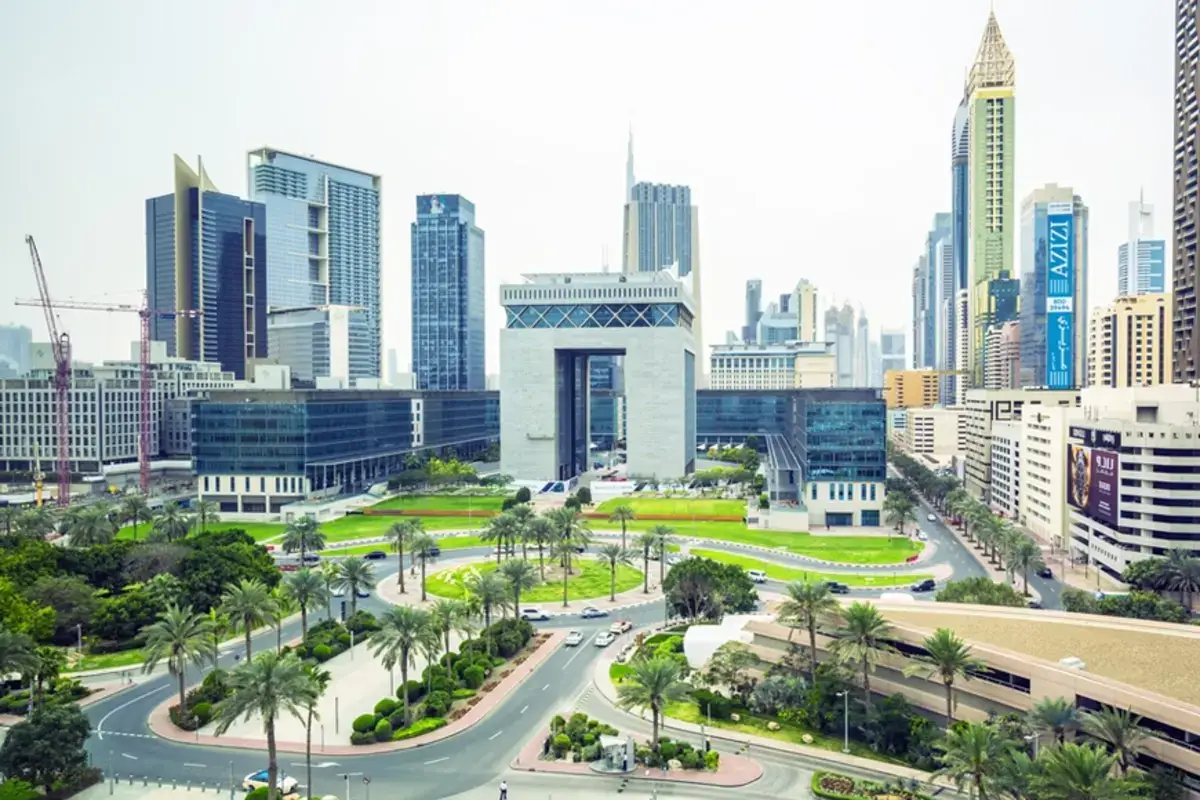
DIFC occupies a strip of land along Sheikh Zayed Road, wedged between Downtown Dubai and the Emirates Towers, and bordered by Zabeel and Al Satwa. This position is not incidental – it puts DIFC within a few minutes’ drive of the Burj Khalifa, The Dubai Mall, Dubai World Trade Centre, and Zabeel Park, while keeping it directly on Dubai’s main north-south artery.
Two Red Line metro stations serve the district directly: Financial Centre Metro Station and Emirates Towers Metro Station, both connecting straight through to Dubai Marina, Downtown Dubai, and Dubai International Airport (roughly a 15-minute drive). RTA bus routes and taxis cover the rest, though residents note that ride-hailing during weekday rush hour and major events (New Year’s Eve, marathons) can be slow given the district’s traffic density.
DIFC is organised into three functional zones — commercial, residential, and retail — which is why a single afternoon in the district can involve a client meeting, lunch at Gate Village, and a walk past a Central Park Towers show apartment.
The Legal and Regulatory Framework
This is the part most lifestyle-focused guides skip, and it’s the part that actually explains why DIFC exists.
DIFC Courts and English Common Law
DIFC laws are written in English and default to English common law wherever a matter is ambiguous — a deliberate design choice that separates DIFC’s commercial, civil, employment, trusts, and securities law from the UAE’s civil law system. The DIFC Courts hear cases with judges drawn from other common law jurisdictions, including England, Singapore, and Hong Kong, and rulings are recognised both within the UAE and internationally. Criminal law and immigration, notably, remain governed by UAE federal law even inside DIFC’s boundaries — the independence is commercial and civil, not total.
The DIFC-LCIA Arbitration Centre (modelled on London Court of International Arbitration rules) handles international arbitration for parties who prefer to resolve disputes outside either court system entirely.
The DFSA: DIFC’s Financial Regulator
The Dubai Financial Services Authority (DFSA) is the independent regulator for all financial services conducted in or from DIFC — banking, insurance, asset management, securities, and increasingly, crypto-asset activity. In 2026, the DFSA has been moving away from a fixed list of “Recognised Crypto Tokens” toward a more principles-based approach, which means DIFC-licensed firms dealing in digital assets now need stronger internal due-diligence and suitability processes rather than relying on a pre-approved token list. This is a meaningful shift for any fintech considering DIFC as a base this year.
Governance Structure
| Body | Role |
|---|---|
| DIFC Authority | Business registration, licensing, and district operations |
| DFSA | Regulates and supervises financial services conducted in or from DIFC |
| DIFC Courts | Independent civil and commercial dispute resolution under common law |
Setting Up a Business in DIFC (2026)
DIFC is best suited to companies in financial and professional services — it is not a general-trading or manufacturing free zone. It permits over 400 distinct licensed business activities across banking, insurance, asset management, securities, payments, legal services, accounting, consulting, and technology, including fintech.
Key Advantages
- 100% foreign ownership — no UAE national sponsor or local partner required
- 0% corporate tax on qualifying income, guaranteed for 50 years from registration; a 9% rate applies to non-qualifying income, still among the lowest in the region
- 0% personal income tax and unrestricted profit repatriation
- Common law jurisdiction — familiar legal footing for international investors and institutions
What It Costs and How Long It Takes
| License type | Typical timeline | Approximate first-year cost |
|---|---|---|
| Commercial (non-regulated) | 10–14 weeks | Lower end of $35,000–$325,000 range |
| Regulated financial services (DFSA) | 16–20 weeks | Upper end of range, plus paid-up capital |
Non-regulated entities generally need at least USD 50,000 in paid-up capital; regulated activities require between USD 100,000 and USD 10 million depending on the license category. A physical office within DIFC’s geographic boundaries is mandatory for most license types — virtual offices are not accepted, with limited exceptions for certain Special Purpose Company (SPV) structures. Applications must go through a DIFC-registered application agent; you cannot self-file.
Who DIFC is a poor fit for: general trading companies moving physical goods, small retail or F&B businesses outside the retail precinct, early-stage founders without the capital to sustain premium fixed costs, and businesses whose primary customer base is the UAE mainland market (DIFC has limited direct access to mainland trade — a mainland Dubai company may be the better structure in that case).
2026 Momentum: The Numbers Behind the Growth
DIFC’s own reporting shows unusually strong momentum in early 2026. In the first quarter alone, 775 new companies established a presence in the Centre — a 62% increase year-on-year (up from 478 in Q1 2025). March 2026 alone saw 258 new company registrations, a 59% jump over March 2025. Family wealth structuring is growing even faster: 158 foundations were registered in Q1 2026, more than double the same period last year (108% growth), with March’s 60 new foundations representing 186% year-on-year growth — evidence that DIFC is increasingly used not just for operating companies but for succession planning and intergenerational wealth governance.
On the infrastructure side, DIFC completed DIFC Square ahead of schedule with full occupancy at handover, and has committed to adding 1.6 million square feet of new commercial space between 2026 and 2027 across three projects: DIFC Living, Innovation Two, and Immersive Tower.
One regulatory change worth flagging for anyone setting up now: Dubai Law No. 7 of 2025 introduces a unified contracting framework across Dubai, including free zones like DIFC. Existing contractors have roughly one year to regularise their status — pointing to a deadline around 8 January 2027, subject to any extension.
Living in DIFC: Real Estate and Residential Life
DIFC evolved from a purely commercial district into a genuine residential neighbourhood, and that shift shows in its skyline. Popular residential towers include Index Tower, Central Park Towers, Sky Gardens, and Burj Daman, offering studios through to four-bedroom apartments and penthouses.
Residents are drawn to DIFC for the same reasons tenants pay a premium here: walkability, direct metro access, proximity to Downtown Dubai and Business Bay, and an unusually high density of dining and retail within a compact footprint. The trade-off, noted consistently by residents, is limited green space — DIFC itself has little parkland, though Zabeel Park is a short drive away — and noise from traffic, construction, and events given the district’s location directly on Sheikh Zayed Road.
Dining, Retail, and Culture
DIFC’s lifestyle identity centres on two hubs: Gate Village and Gate Avenue.
Gate Village combines contemporary art galleries with a dense cluster of restaurants ranging from Michelin-recognised fine dining to casual lunch spots — a favourite for business lunches as much as weekend dinners. Gate Avenue, meanwhile, is DIFC’s boutique retail spine, home to fashion and lifestyle stores such as Sacoor Brothers and Suit Supply, alongside wellness studios and cafés, with The Dubai Mall a short trip away for larger-format shopping.
The district’s most photographed cultural landmark, the Museum of the Future, sits just at DIFC’s edge, and the Emirates Towers – for years Dubai’s tallest buildings — mark the district’s other visual boundary. Together they frame DIFC’s skyline as distinctly Dubai: sleek glass towers softened by galleries, courtyards, and pedestrian streets rather than pure high-rise density.
Hotels in DIFC
Three international five-star properties operate within the district: the Ritz-Carlton, DIFC, the Four Seasons Hotel DIFC, and the Waldorf Astoria Dubai International Financial Centre. All three combine business-traveller convenience — walking distance to offices and the metro — with the fine dining and spa amenities expected of their brands, making DIFC a common base for executives visiting for meetings rather than leisure.
Schools, Healthcare, and Family Life
DIFC is not designed around families the way a suburban Dubai community is, but it is workable for professional households. Nearby options include British and American curriculum schools in Downtown Dubai and adjacent communities, alongside nurseries such as Hummingbird Nursery and branches of British Orchard Nurseries within DIFC itself. The DIFC Academy offers financial-services training for working professionals, and London Business School runs postgraduate programmes from a DIFC campus.
Healthcare is covered by clinics and centres within and around the district, including general practice, dental, and wellness facilities, with larger hospitals a short drive away in Downtown Dubai and Jumeirah.
DIFC Compared to Other Dubai Free Zones
| Factor | DIFC | JAFZA | Dubai Mainland |
|---|---|---|---|
| Best for | Financial & professional services | Logistics, import/export, manufacturing | General trading, retail, mainland market access |
| Governing law | English common law | UAE civil law | UAE civil law |
| Foreign ownership | 100% | 100% | 100% (most sectors) |
| Corporate tax | 0% on qualifying income, 50-year guarantee | UAE standard free zone rules apply | UAE standard corporate tax applies |
| Access to UAE mainland market | Limited, direct | Limited, direct | Full |
| Physical office requirement | Mandatory for most licenses | Varies by license | Varies |
The practical rule of thumb: choose DIFC if your core business is financial or professional services and you want common law certainty; choose JAFZA if you need logistics or manufacturing infrastructure; choose mainland Dubai if unrestricted access to UAE domestic customers is the priority.
Pros and Cons of DIFC at a Glance
Strengths: unmatched legal certainty for international investors, deep concentration of financial institutions and professional talent (DIFC hosts 17 of the world’s top 20 banks and seven major global law firms), walkable live-work-play design, strong connectivity, and a 50-year tax guarantee that few jurisdictions anywhere can match.
Trade-offs: premium real estate and setup costs relative to other Dubai free zones, mandatory physical office requirements that rule out lean or virtual setups, limited direct mainland market access, and a district-level shortage of green space and quiet residential streets.
Frequently Asked Questions
What is the Dubai International Financial Centre (DIFC)?
DIFC is a 110-hectare financial free zone in central Dubai, established in 2004. It operates under English common law, its own courts, and its own financial regulator, and functions as both a global business hub and a residential, dining, and cultural district.
Is DIFC part of the UAE mainland legal system?
No. DIFC has its own civil, commercial, and employment law framework based on English common law, enforced by the independent DIFC Courts. UAE federal law still applies to criminal matters and immigration within DIFC’s boundaries.
Who regulates financial services in DIFC?
The Dubai Financial Services Authority (DFSA) is DIFC’s independent financial regulator, overseeing banking, insurance, asset management, securities, and fintech activity conducted in or from the Centre.
Do companies in DIFC pay corporate tax?
Companies in DIFC benefit from a 0% corporate tax rate on qualifying income, guaranteed for 50 years from registration, as DIFC is a qualifying free zone under the UAE Corporate Tax Law. A 9% rate applies to non-qualifying income.
How much does it cost to set up a company in DIFC in 2026?
First-year costs typically range from roughly USD 35,000 to USD 325,000, depending on license type, office requirements, and whether the DFSA regulates the activity. Regulated licenses also require paid-up capital of USD 100,000 to USD 10 million.
How long does DIFC company registration take?
Non-regulated commercial licenses typically take 10–14 weeks; regulated financial services licenses requiring DFSA approval take 16–20 weeks.
Can I get a virtual office in DIFC?
Generally no. Most DIFC licenses require a physical office within the Centre’s geographic boundaries, with limited exceptions for certain Special Purpose Company (SPV) structures.
Is DIFC a good place to live?
DIFC suits professionals and investors who want a central, walkable address near Downtown Dubai with strong metro connectivity, dining, and retail. It has less green space than suburban communities and can be noisy given its location on Sheikh Zayed Road.
What residential towers are located in DIFC?
Popular options include Index Tower, Central Park Towers, Sky Gardens, and Burj Daman, offering studios to four-bedroom apartments and penthouses.
What hotels are in DIFC?
Three five-star hotels operate within the district: the Ritz-Carlton DIFC, the Four Seasons Hotel DIFC, and the Waldorf Astoria Dubai International Financial Centre.
How is DIFC different from JAFZA or Dubai mainland?
DIFC specialises in financial and professional services under common law; JAFZA specialises in logistics, trade, and manufacturing; mainland Dubai companies get full access to the UAE domestic market, which DIFC and other free zones do not offer directly.
How is DIFC performing in 2026?
DIFC reported 775 new company registrations in Q1 2026, a 62% year-on-year increase, alongside 158 new foundations registered for wealth and succession planning — up 108% year-on-year — reflecting continued investor confidence in the Centre.
What is being built in DIFC between 2026 and 2027?
DIFC is adding roughly 1.6 million square feet of new commercial space, including DIFC Living, Innovation Two, and Immersive Tower, following the early completion and full occupancy of DIFC Square.
Key Takeaways
DIFC is a financial free zone, an independent common law jurisdiction, and a residential and cultural district occupying the same 110 hectares in central Dubai. Its regulatory backbone — the DFSA and DIFC Courts — gives international businesses a familiar legal environment rarely found elsewhere in the region, backed by a 50-year zero-tax guarantee on qualifying income. Its physical district, anchored by Gate Village, Gate Avenue, and towers like Index Tower and Central Park Towers, has become one of Dubai’s most walkable and dining-dense neighbourhoods. And its 2026 numbers — a 62% jump in new company registrations and a 108% rise in new foundations — suggest the Centre’s dual identity as both jurisdiction and neighbourhood is only deepening.

- Ismail Kouami: The Dubai Entrepreneur Building Companies Across Fintech, Mobility and Software - September 13, 2026
- 7 Costly Mistakes Entrepreneurs Make Before Hiring Company Setup Consultants in Dubai - September 5, 2026
- How Monthly Car Hire Simplifies Transportation During Home Relocations - July 27, 2026