Emirates Golf Club Area Guide 2026: Courses, Fees, Location and What to Expect
If you’ve searched for Emirates Golf Club, you’re probably trying to sort out one of a few things: which course to play, how much it actually costs, how to get there without getting lost on Sheikh Zayed Road, or whether the neighborhood around the club is worth a closer look if you’re relocating to Dubai. This guide answers all of it in one place.
Emirates Golf Club isn’t just a golf course. It’s a 36-hole complex, a residential community, an event venue that hosts one of the DP World Tour’s flagship stops, and a genuine piece of Dubai’s modern history — it was the first all-grass championship golf course built in the Middle East. Understanding the club means understanding all four of those layers at once, and that’s what this guide sets out to do: a single, comprehensive resource covering the courses, the surrounding area, real costs, and what to expect whether you’re playing a round, attending the Hero Dubai Desert Classic, or considering a home nearby.
What Is Emirates Golf Club?
Emirates Golf Club is a 36-hole golf complex located in Al Thanyah Third, just off Sheikh Zayed Road in Dubai. It was built in 1988, with the clubhouse and facilities designed and delivered by Dubai architect BSBG (Brewer Smith Brewer Group), making it the first grass golf course in the Middle East. Before Emirates Golf Club, golf in the region was played almost exclusively on sand and oiled-sand “browns” rather than turf, so its opening marked a genuine turning point for the sport in the Gulf.
The club is built around two championship 18-hole courses — the Majlis and the Faldo — plus a par-3 academy course, making it one of the largest golf facilities in the UAE. Beyond golf, it functions as a full leisure club with dining, a pool, tennis and squash courts, and an adjoining residential community of villas that carries the club’s name.
Quick facts
| Attribute | Detail |
|---|---|
| Location | Al Thanyah Third, off Sheikh Zayed Road, Dubai |
| Opened | 1988 |
| Courses | Majlis (par 72), Faldo (par 72), Par 3 Academy Course |
| Course architect | Karl Litten (original design); Sir Nick Faldo (Faldo Course redesign, 2006) |
| Clubhouse design | BSBG (Brewer Smith Brewer Group) |
| Signature event | Hero Dubai Desert Classic (DP World Tour, Rolex Series) |
| Nearest metro | Al Fardan Exchange Station (Red Line) |
The History Behind Emirates Golf Club
The story of Emirates Golf Club is closely tied to Dubai’s own transformation from a trading port into a global city. The idea of a completely grassed championship golf course in Dubai was brought about by American businessman Larry Trenary and British businessman George Atkinson, both living in Dubai on a full-time basis, with the course design provided by American architect Karl Litten.
A proposal for a golf course was eventually presented to Sheikh Mohammed bin Rashid Al Maktoum, and after discussing the concept during a hunting trip with Pakistani President Zia-ul-Haq — himself a keen golfer — Sheikh Mohammed took the idea to his older brother, then-Ruler of Dubai Sheikh Maktoum bin Rashid Al Maktoum, who approved it. Sheikh Mohammed then designated roughly 175 acres of desert dunes just outside the city center for the course, clubhouse, and maintenance facilities.
The complex opened for business in 1988, with President Zia in attendance to hit the ceremonial first ball off the driving range. That founding year is why you’ll consistently see Emirates Golf Club described as the “home of golf” in the Middle East — it predates every other grass course in the region.
Since then, the club has hosted the Dubai Desert Classic every year from 1989 onward, along with the Omega Dubai Ladies Classic on the women’s tour, cementing its role as the region’s original tournament venue rather than simply its first golf course.
The Courses at Emirates Golf Club
Emirates Golf Club’s 36 holes are split between two very different championship layouts, plus a shorter course built for practice and beginners. Knowing the difference matters, because the Majlis and Faldo attract distinct types of golfer.
The Majlis Course
The Majlis is the club’s flagship layout and the one that hosts the Hero Dubai Desert Classic. Established in 1988, it was the first grass course in the Middle East, and today it plays as a challenging par-72 layout stretching to 7,301 yards. Its name comes from the Arabic word for “meeting place,” a nod to the original clubhouse concept.
The course winds through natural desert dunes rather than flattened terrain, and its defining features are the seven fresh and saltwater lakes woven through the fairways. The 18th hole in particular is regarded as one of the best finishing holes in golf: a dogleg fairway that tempts players to cut the corner, followed by an approach shot that must clear water to reach a green that has decided the outcome of the Dubai Desert Classic many times over. The course record belongs to Ernie Els, who shot a 61 on 27 January 1994.
Because the Majlis is a working tournament venue, it enforces stricter standards than a typical resort course. Visitors need a valid handicap certificate, with a maximum index of 28 for men and 36 for ladies, and the club operates a soft-spike-only policy — metal spikes aren’t permitted.
The Faldo Course
Emirates Golf Club’s second championship golf course opened in 1996 under the name “The Wadi,” taken from the Arabic word for valley. It was substantially redesigned by Sir Nick Faldo in 2006 and renamed in his honor. The Faldo Course is longer than the Majlis at roughly 7,328–7,348 yards depending on tee configuration, with more dramatic bunkering from tee to green.
Its standout feature is that it’s fully floodlit — the only 18-hole championship course in the region that can genuinely be played after dark, using LED lighting technology. For visitors dealing with Dubai’s midday heat between May and September, an evening round on the Faldo is often the more comfortable option, and reviewers consistently describe the night-golf experience as one of the club’s most memorable offerings.
Par 3 Academy Course
Rounding out the 36 holes is a nine-hole Par 3 Academy Course, designed for beginners, juniors, and golfers working on their short game rather than a full round. It sits alongside the Emirates Golf Academy’s practice facilities, including two full-length driving ranges, chipping areas, and putting greens — making the club a genuine base for improving your game, not just playing it.
Course Comparison at a Glance
| Feature | Majlis Course | Faldo Course |
|---|---|---|
| Opened | 1988 | 1996 (redesigned 2006) |
| Par | 72 | 72 |
| Length | ~7,301 yards | ~7,328–7,348 yards |
| Designer | Karl Litten | Karl Litten / redesigned by Nick Faldo |
| Signature feature | Hosts the Hero Dubai Desert Classic | Only floodlit 18-hole course in the region |
| Best suited for | Tournament-style challenge, desert dune terrain | Evening play, longer resort-style test |
Location, Access and Getting There
Emirates Golf Club’s official address is 17/2 Al Naseem Street, Al Thanyah 3, Hadaeq Mohammed Bin Rashid, Dubai. It sits directly off Sheikh Zayed Road (E11), within the Emirates Hills and The Greens/Views cluster of communities, and close to Dubai Marina, JLT, and Dubai Internet City.
The club’s central position places it within a short drive of Dubai’s main business hubs, such as Dubai Media City and Internet City, and roughly 25 minutes from Dubai International Airport.
By metro: The area is well served by the Dubai Metro, with Al Khail Metro Station (previously known as Nakheel Metro Station) located just outside the club’s main entrance on the Red Line. During the Hero Dubai Desert Classic, the closer stop is Al Fardan Exchange Station, which sits right at the tournament entrance.
By car: The club is directly accessible from Sheikh Zayed Road via the Al Thanyah 3 exit, with dedicated on-site parking for regular club visitors (note that during tournament week, on-site public parking is suspended in favor of metro-based “park and ride” from nearby stations).
By bus: Public bus routes operated by the RTA serve the surrounding area, including routes 83, F58, F35, F31, and JLT-1, connecting the club to Sheikh Zayed Road, JLT, Dubai Internet City, and The Greens community.
Green Fees, Membership and What It Actually Costs
Pricing at Emirates Golf Club is seasonal and course-dependent, so treat any figure as an approximate benchmark rather than a fixed rate — always confirm live pricing through the club’s official booking app before you travel.
Visitor green fees (approximate, 18 holes):
| Course | Off-peak (weekday) | Peak (Fri–Sun & public holidays) |
|---|---|---|
| Majlis | ~AED 950–995 | ~AED 1,000–1,100 |
| Faldo | ~AED 550–595 | ~AED 650–695 |
| Par 3 Academy | Lower, pay-per-session rate | Lower, pay-per-session rate |
Green fees are inclusive of shared golf cart hire (outside of walking season) and one hour of driving range access before play. The Majlis, as the tournament course, consistently commands a premium over the Faldo — expect to pay roughly 50–70% more to play it.
Membership: Annual membership at Emirates Golf Club sits at the premium end of Dubai’s golf market. At clubs of this caliber, membership fees can exceed AED 100,000 annually, covering unlimited golf access along with fitness, dining, and social facilities. Members and residents of the adjacent Emirates Golf Club villa community typically receive preferential rates on green fees for guests.
Money-saving tip: Rates drop noticeably in the off-peak summer months (roughly May through September), when heat keeps casual play lower. Booking through the club’s official Viya app is generally the most reliable way to access current promotional rates rather than rack rates quoted by third-party resellers.
The Hero Dubai Desert Classic 2026
Emirates Golf Club’s Majlis Course is best known internationally as the home of the Hero Dubai Desert Classic, a Rolex Series event on the DP World Tour and the oldest professional golf tournament in the Middle East.
The 2026 edition — the 37th staging of the tournament — runs from Thursday, 22 January to Sunday, 25 January 2026, once again at the Majlis Championship Course. The field is headlined by Rory McIlroy, who returned chasing a record fifth Dallah Trophy, marking 20 years since his first appearance in the tournament as an amateur in 2006. He was joined by defending champion Tyrrell Hatton along with Ryder Cup stars Viktor Hovland and Shane Lowry, and two-time major winner Dustin Johnson.
General admission was free for spectators on Thursday and Friday, while weekend access for adults on Saturday and Sunday was priced at AED 100 in advance (AED 125 at the door), with children under 17 admitted free when registered alongside an adult. Premium hospitality options, such as the Dallah Lounge, offered elevated views over the course alongside all-day dining.
Why this matters for an area guide: if you’re planning any visit to the neighborhood during tournament week (typically mid-to-late January), expect road closures near the club, suspended on-site parking, and a noticeable increase in metro traffic through Al Fardan Exchange Station. Outside of the tournament, the area returns to its normal, low-key residential and leisure rhythm.
The Clubhouse, Dining and Amenities
Emirates Golf Club’s dining scene includes Jones the Grocer, a relaxed gourmet café ideal for breakfast, brunch, or casual meals with golf-course views; the Spike Bar, a sports bar serving classic pub fare with screens for live sport; and Carine, offering French-Mediterranean cuisine in a more refined setting.
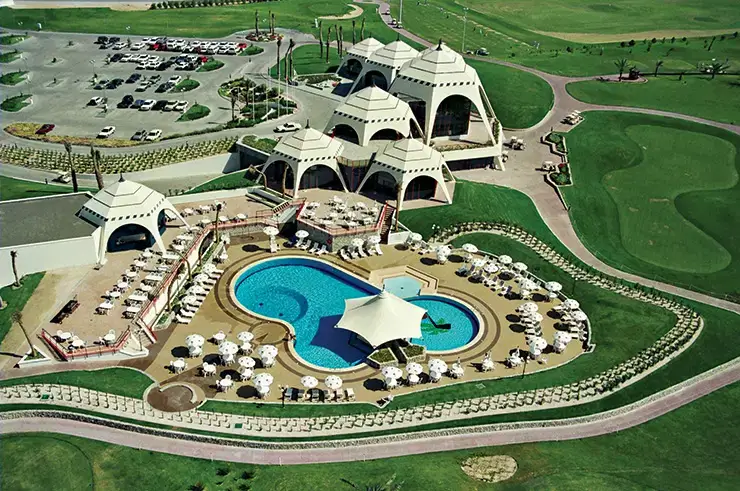
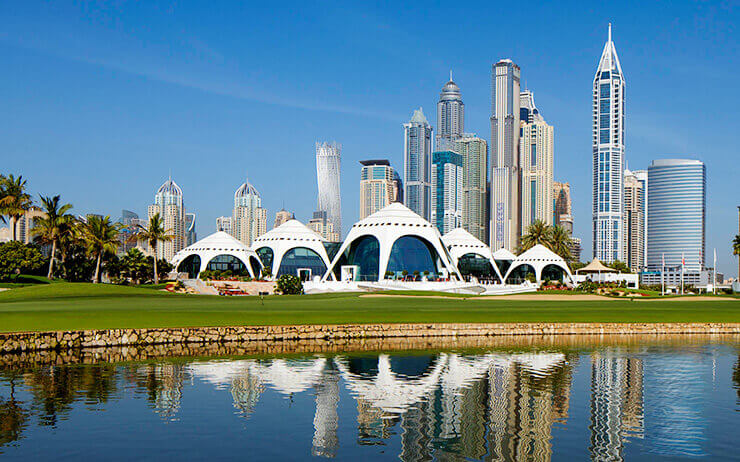
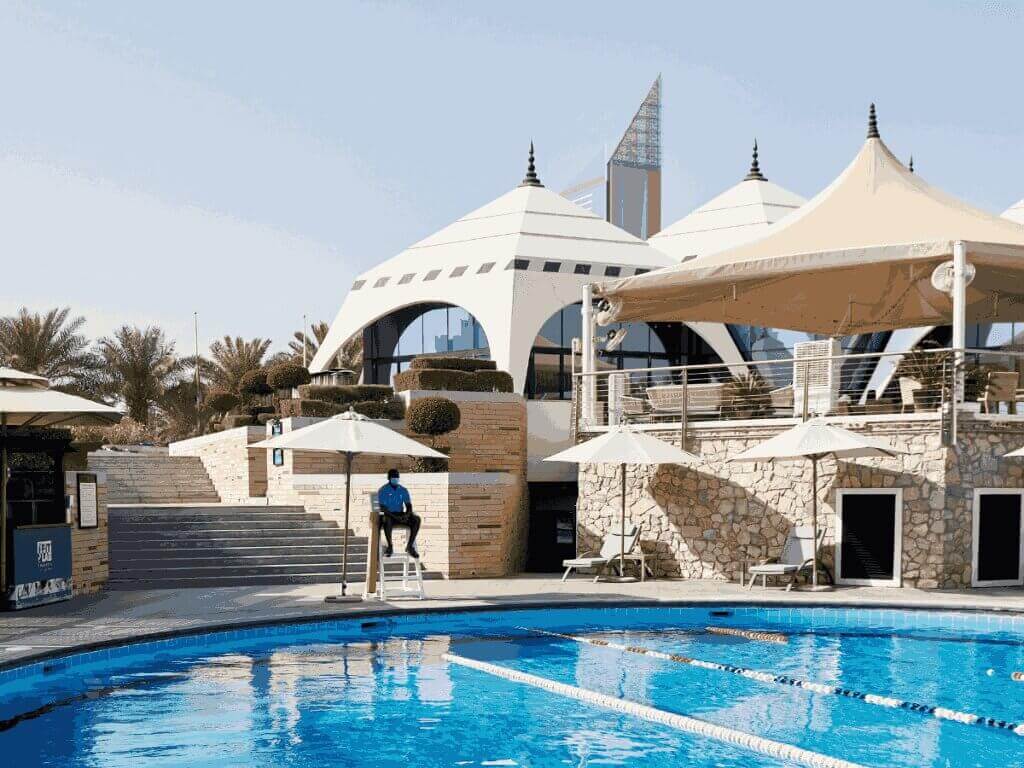
The clubhouse itself, shaped to echo a cluster of Bedouin tents, is one of the most recognizable pieces of architecture in Dubai’s sporting landscape. Beyond golf and dining, members and residents have access to a swimming pool, gym, and tennis and squash courts, positioning the club as a full leisure destination rather than a single-purpose golf facility — useful context if you’re evaluating it as a lifestyle amenity for a nearby home rather than as a one-off round of golf.
Emirates Golf Club as a Residential Community
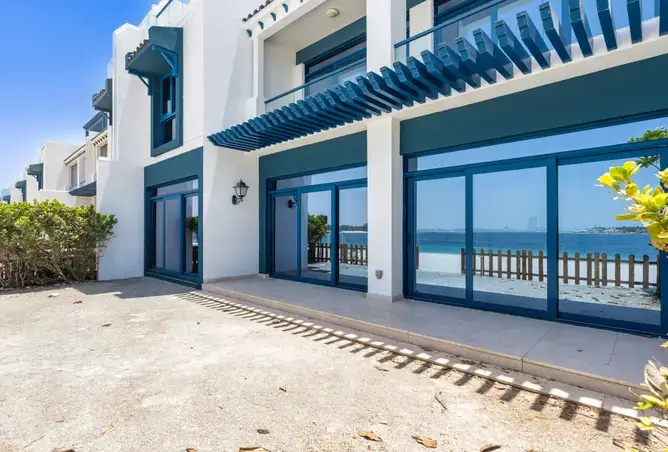
Alongside its golf and events role, “Emirates Golf Club” also refers to a small, exclusive residential enclave of villas built around the course itself. The residential offering here is highly exclusive, consisting mainly of luxury villas designed for buyers seeking privacy, space, and direct access to the club’s amenities, with 84 villas overlooking the fairways.
This puts it in the same conversation as neighboring Emirates Hills, Dubai’s most prestigious gated villa community, which borders The Meadows, The Springs, and The Lakes and looks out over the neighboring Montgomerie Golf Club. Residents of both communities share the same broad advantages: direct or near-direct golf-course frontage, quick access to Sheikh Zayed Road, and proximity to Dubai Marina, JLT, and Dubai Internet City without sitting inside the density of those areas.
Nearby Attractions and Neighborhoods
Because of its Sheikh Zayed Road location, Emirates Golf Club sits within easy reach of several of Dubai’s most visited districts, which is worth knowing whether you’re staying nearby for a golf trip or considering the area for relocation.
- Dubai Marina — waterfront dining, JBR beach, and the Marina Walk, a short drive away
- Dubai Internet City & Media City — Dubai’s main tech and media business hubs
- The Greens and The Views — established mid-rise residential communities directly adjacent to the club
- Montgomerie Golf Club — a second championship course in Emirates Hills, designed by Colin Montgomerie
- Topgolf Dubai — a more casual, social golf-entertainment venue nearby, part of the same Dubai Golf portfolio
Practical Tips for First-Time Visitors
A few details consistently trip up first-time visitors and are worth planning around before you arrive.
Handicap certificate is mandatory. Both the Majlis and Faldo require visiting golfers to present a valid handicap certificate from their home club, capped at 28 for men and 36 for ladies. Without one, you may be turned away or restricted to the Par 3 Academy Course.
Dress code is enforced. Collared shirts and proper golf shorts, skirts, or trousers are required; players arriving improperly dressed will be asked to change before they’re allowed onto the range or course.
Soft spikes only. Metal spikes are not permitted on either championship course.
Book ahead, especially on weekends. Friday and Saturday tee times fill quickly and carry peak pricing; weekday and evening slots (particularly on the floodlit Faldo Course) tend to be both cheaper and easier to secure.
Consider club hire over transport. Several visitor reviews recommend renting a set on arrival rather than flying with your own clubs, since rental equipment at the club is generally well maintained and saves the hassle of golf-bag logistics through the airport.
Emirates Golf Club vs Other Dubai Golf Clubs
| Club | Established | Signature Feature | Best Known For |
|---|---|---|---|
| Emirates Golf Club | 1988 | First grass course in the Middle East; floodlit Faldo Course | Hero Dubai Desert Classic |
| Jumeirah Golf Estates | 2009 | Earth and Fire courses | DP World Tour Championship |
| Dubai Creek Golf & Yacht Club | 1993 | Iconic sail-shaped clubhouse | Waterfront, city-center setting |
| Address Montgomerie, Dubai | 2002 | Colin Montgomerie design, 14 lakes | Links-style layout in Emirates Hills |
| Trump International Golf Club, Dubai | 2017 | Gil Hanse design, largest clubhouse in Dubai | Damac Hills community golf |
Emirates Golf Club’s distinguishing position among these is historical rather than just architectural — it’s the original, and it remains the only regional venue offering a genuinely floodlit championship-length course alongside its tournament layout.
Key Takeaways
Emirates Golf Club is a 36-hole complex in Al Thanyah Third, Dubai, built in 1988 as the first grass golf course in the Middle East. It comprises the tournament-grade Majlis Course, the floodlit Faldo Course, and a Par 3 Academy Course, alongside dining, leisure facilities, and an exclusive villa community. It sits directly off Sheikh Zayed Road near Al Fardan Exchange Metro Station, roughly 25 minutes from Dubai International Airport, and hosts the Hero Dubai Desert Classic — a DP World Tour Rolex Series event — every January, most recently 22–25 January 2026.
FAQs
Where is Emirates Golf Club located?
Emirates Golf Club is located at Al Naseem Street, Al Thanyah 3, Hadaeq Mohammed Bin Rashid, Dubai — directly off Sheikh Zayed Road, near Emirates Hills and Dubai Marina, and about 25 minutes from Dubai International Airport.
Is Emirates Golf Club the oldest golf club in Dubai?
Yes. Opened in 1988, it was the first all-grass championship golf course built in the Middle East, predating every other grass golf course in the region.
How many golf courses does Emirates Golf Club have?
Three: the championship Majlis Course, the floodlit championship Faldo Course, and a nine-hole Par 3 Academy Course for beginners and short-game practice.
What is the green fee at Emirates Golf Club?
Approximate 18-hole visitor rates range from around AED 550–695 on the Faldo Course to roughly AED 950–1,100 on the Majlis Course, depending on the day of the week and season. Always confirm live pricing before booking, as rates change seasonally.
Do I need a handicap certificate to play?
Yes. Visitors need a valid handicap certificate, capped at 28 for men and 36 for ladies, to book a round on either the Majlis or Faldo courses.
Can you play golf at Emirates Golf Club at night?
Yes, on the Faldo Course, which is fully floodlit using LED lighting technology and is the only 18-hole championship course in the region playable after dark.
What tournament does Emirates Golf Club host?
The Hero Dubai Desert Classic, a Rolex Series event on the DP World Tour and the oldest professional golf tournament in the Middle East, held annually on the Majlis Course, most recently 22–25 January 2026.
Is Emirates Golf Club close to the metro?
Yes. Al Khail (formerly Nakheel) Metro Station on the Red Line sits just outside the club’s main entrance, and Al Fardan Exchange Station serves the club directly during tournament events.
Can non-members play at Emirates Golf Club?
Yes, visitors are welcome daily on both championship courses, subject to a valid handicap certificate and advance tee-time booking, ideally through the club’s official Viya app.
Is there residential property at Emirates Golf Club?
Yes. Roughly 84 exclusive villas sit directly within the club grounds, offering golf-course frontage and access to club amenities, distinct from but neighboring the larger Emirates Hills community.
How much does membership cost at Emirates Golf Club?
Annual membership at this tier of club typically runs upward of AED 100,000, covering unlimited golf access plus fitness, pool, and dining facilities, though exact tiers and pricing should be confirmed directly with the club.
What is the difference between the Majlis and Faldo courses?
The Majlis is the original 1988 tournament course, home to the Hero Dubai Desert Classic and built into natural desert dunes. The Faldo, redesigned by Nick Faldo in 2006, is slightly longer, features more dramatic bunkering, and is fully floodlit for night play.
How far is Emirates Golf Club from Dubai Marina?
It’s a short drive of around 10–15 minutes, making it a practical golf option for anyone staying in the Marina, JBR, or JLT areas.

- Umm Suqeim Dubai Area Guide 2026: Beaches, Villas, Schools and Local Life - August 6, 2026
- Emirates Golf Club Area Guide 2026: Courses, Fees, Location and What to Expect - July 14, 2026
- Al Maktoum International Airport: Your Ultimate Real Estate Investment Guide in Dubai South (2026-2032) - June 22, 2026